


Saturday, October 21, 2006
Arden: A Shakespearean Second Life

Looks like even academics are getting into the virtual world space. Edward Castronova, author of Synthetic Worlds, a book about massively multiplayer online games (MMOs), is planning on bringing the world of Shakespeare's Richard III to life. With the help of a $240,000 grant from the MacArthur Foundation, he is going to create Arden, a virtual world like Second Life teeming with political intrigue, secret conniving, deal-making and war.
One key difference is that there are plans to test how different environmental conditions lead to different outcomes.
"Now we have this technology for making little pocket societies and we can do different governments, different economies, different social norms in the different environments," he said, "and see how it affects the things we care about, like equality and justice and growth and efficiency."Where does the learning come in? Shakespearean texts will be key in the game.
"If you collect the 'To be or not be' speech and then take it to a lore master or to a skilled bard, he can then apply the magic to your broad sword or you (could) utilize the magic in a battle situation to give you this massive (advantage)," Castronova explained. "So there (will be) this intensive competition to get the best speeches of Shakespeare in your play book.Arden sounds very promising, combining education and entertainment. As other similar projects show, wrapping an intrinsically boring (to some) task in the veil of a game is often effective in getting higher rates of user participation (i.e. getting kids to stay awake in class).
Labels: Technology


Solve a Sudoku Puzzle without Thinking
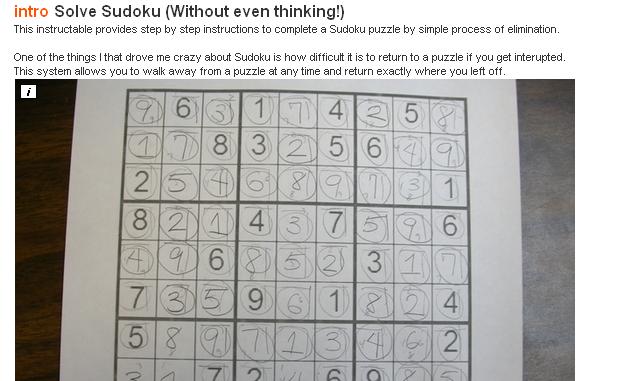
Instructable's user delgaudm has a provided step-by-step instructions on how to solve a Sudoku puzzle without thinking. He (?) takes you through a nine step process of elimination, illustrated with a sample puzzle. I've seen other tutorials on solving Sudoku puzzles, but this is easily my favorite. It's concise, and I like the use of pencil and paper in illustrating the process.
A warning though: after learning the solution process, you might be a little less thrilled at playing Sudoku since it kind of becomes a mechanical process. Just work through the steps, and you'll be able to solve any puzzle.
Solve Sudoku (Without even thinking!)
Labels: Technology
Paint.NET 3.0 Alpha Released: Much Better Than v2.72
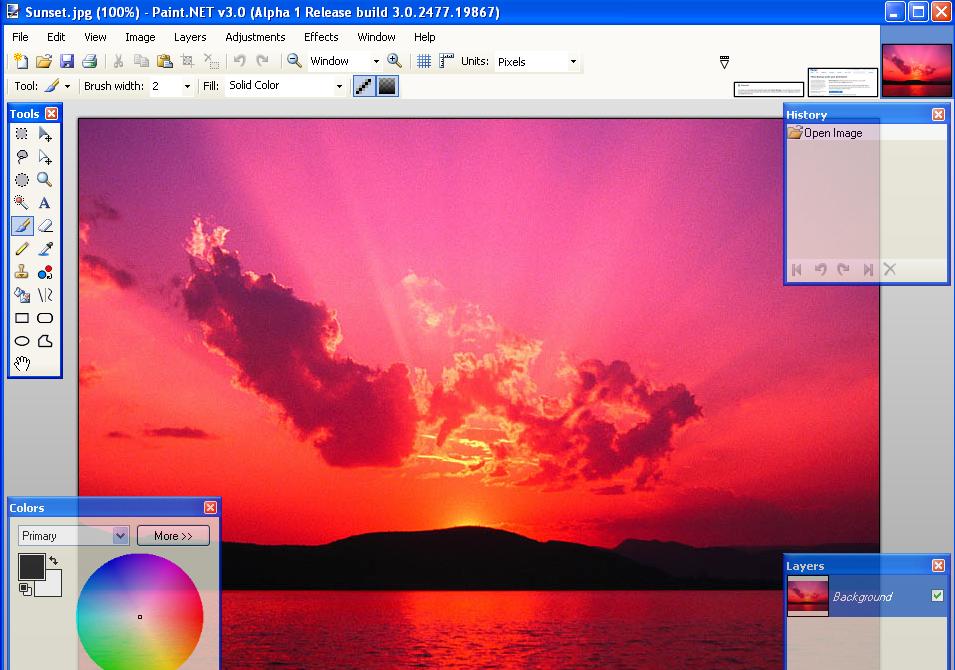
Earlier, we recommended Paint.NET as a superior alternative to Microsoft Paint and even Photoshop for some users. Version 3.0 alpha of Paint.NET (download here) was just released in the past week.
From some testing, it looks to be a far superior release than previous versions. It loads a lot faster, and tabs have been implemented to show thumbnails of all the opened images.
Here are the latest changes:
- Brand new Multiple Document Interface (MDI) with tabs that show thumbnails for all the opened images
- Colors window now supports a color palette, along with the ability to manage multiple named custom palettes
- Colors window now uses value sliders that more clearly show how the color is being manipulated
- Floating windows now better support docking and snapping, and remember their positions across sessions
- Brand new icon and logo, including full 256x256 icon so that it looks great on Vista
- Toolbar is context dependent: only the toolbar items relevant to the current tool are shown
- Tolerance control moved to the toolbar
- Ability to choose default values for toolbar items, as well as the tool that is selected at startup
- Ability to draw with "smooth" or "sharp" text. Smooth text is good most of the time, and sharp text is good for when 'smooth' doesn't look good (sometimes for small text), or for doing GUI mockups
- UI for update checking, downloading, and installing is better
- "Edit -> Paste in to New Image" replaces "File->Acquire from Clipboard", and is accessible with Ctrl + Alt + V
- Updates and Language commands moved to Help menu
- History window now uses much less memory and significantly fewer User/GDI handles
- Session temporary data is now compressed if the file system is NTFS. This results in less disk I/O and thus higher performance
- Font list dropdown loads much quicker
Labels: Technology
Blogger Outage?

Looks like Blogger's problems aren't ending anytime soon. I couldn't access my Blogger account to post for about 4 hours earlier today, getting a 503 error. Anyone else experience this?
The blogspot.com domain was available though.
With the recent discovery of a Blogger security flaw that allows posts on one blog to show up on another, I'm starting to wonder about Blogger's stability. As far as I know, there wasn't a scheduled outage this afternoon.
As I was trying to post this, I got another error message:
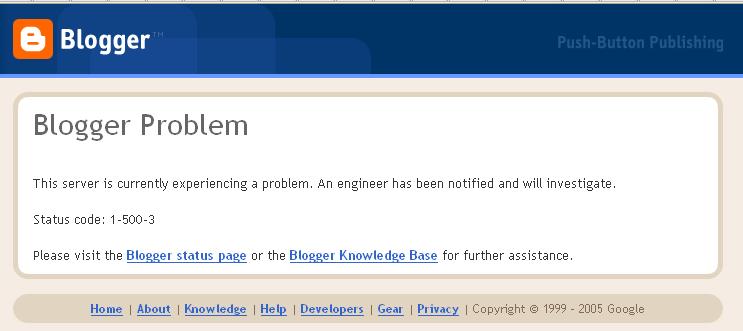
Update: Looks like everything's back to normal.
Labels: Technology
Kizmeet: Find Missed Connections
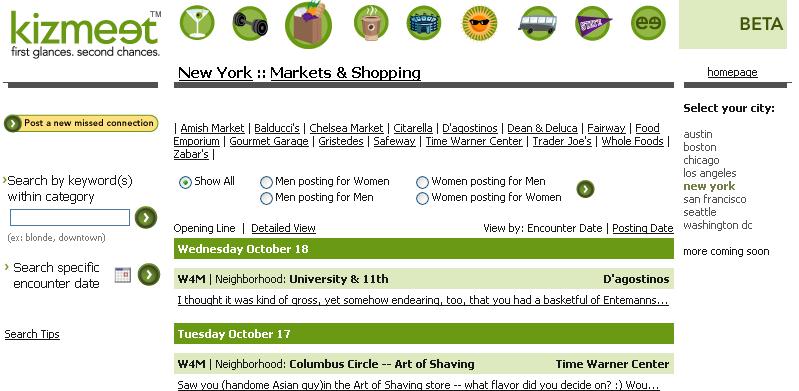
RB- The vodka tonics were so friggin strong last night- were you trying to get me drunk? Thanks for the drink and conversation. I liked talking to you.- LDThe post is marked W4W, meaning woman looking for woman. Date and location of encounter are also listed (October 18, 2006, Normandie Room). This is a random posting I fished out of the fairly small pool right now at Kizmeet, a site billed as helping users find missed connections. One example is a brief glance at someone across a bar. Someone you don't know, but want to find again.
Registered in May, Kizmeet is a novel service. It's one of those ideas that's only feasible because the Internet exists. Missed connections are common, and as far as I know, Kizmeet is the only player in this rather narrow subspace of social networking sites. Eight cities are currently supported with more to come. Detail is important; every piece of information in a post narrows down the search space by large swathes.
If the site gets popular, the UI might need reworking so users can easily scan or search through posts that are at best vague descriptions. One factor working against this is the one month life of a post. Older posts drop off as they should since memories of brief encounters fade quickly so finding a missed connection becomes less important.
Kizmeet has the feel of a dating or social networking site, but it's neither, which could be a disadvantage. The appeal is somewhat limited at the beginning since a large number of users is needed to make the service work. Network effects don't kick in unless the site becomes mainstream enough. As more users join or read the postings, the chance of actually making a missed connection increases. I'd be interested in getting statistics on successful connections as time passes.
On a side note, I love this FAQ question: Of the 4 million Starbucks in my city, how do I know I'm searching the right one for my missed connection?
Labels: Technology
Blufr: Telling Truths from Lies

Blufr is a simple game from the owners of Answers.com: you answer true or false when presented with a random "fact". The score you get at the end is the result of both real and fake measures so it doesn't mean much, but the game is somewhat addictive.
Much like Google Image Labeler, Answers.com has transformed a dry, boring subject matter into an interactive game. I wonder whether a modified Blufr could be used to train a neural network or a Cyc-like artificial intelligence. There are generally two schools of thought on AI: the bottom-up and top-down perspectives. Bottom-up is essentially starting with simple rules in the hopes of getting emergent properties. Top-down is like Cyc, which is based on a vast collection of facts. The idea is that Cyc can answer questions by parsing them with natural language processing and going into its knowledge base to answer them.
Getting a high quality database of facts is hard since you can quantify so many things. A Blufr-like game would be a quick and dirty solution, speeding up the process significantly.
Related Reading:
How to Detect Lies
Yahoo! Shortcuts, Instant Search, and Natural Language Search
Labels: Technology
Friday, October 20, 2006
iFilm Beta Launches
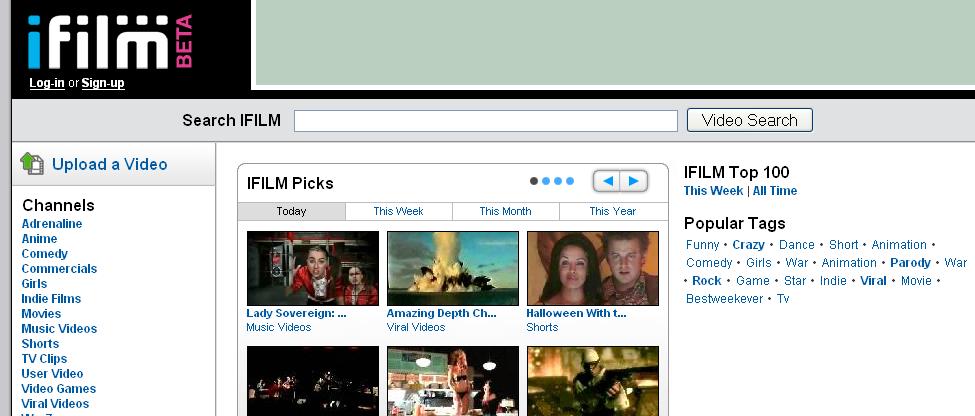
iFilm has finally started changing with the times by launching a beta site that incorporates a lot of features characteristic of the new wave of video sharing sites. Ditching the clunky pop-up iFilm player for a sleeker Flash based media player, the new UI is cleaner and less crowded. Tagging is supported, but embedding is missing. A search box is also prominently displayed.
No telling if the beta UI will stay intact when it debuts officially, but it is much improved from the current interface.
Labels: Technology
Quantcast: A Better Alexa?
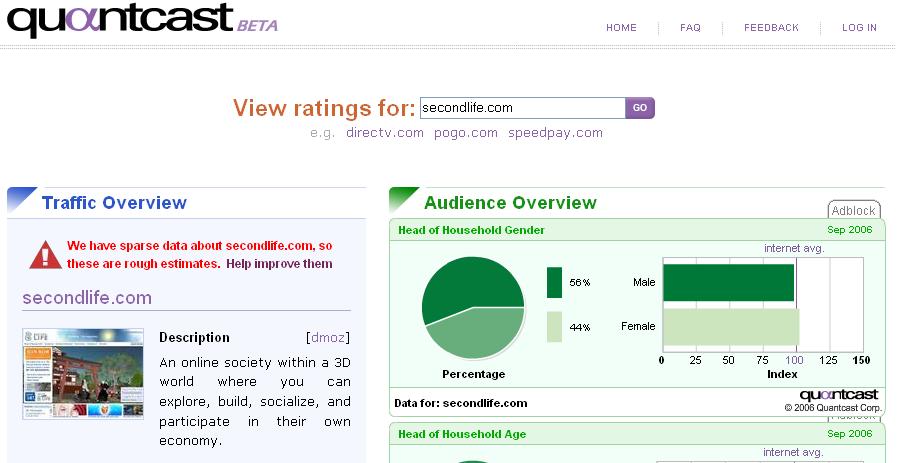
Quantcast is shaping up to be a better Alexa. Started by a team of web analytics experts, it provides a depth Alexa is missing like age, sex, and ethnicity of a site's audience. It might be better described as complementary to Alexa since Quantcast doesn't convey as much detail on traffic rankings. The two sites' methodologies are quite different.
Alexa depends on users of the Alexa toolbar to determine traffic rankings, which has led to criticism that it isn't really representative since only tech savvy users use it to any great degree. By contrast, Quantcast has apparently signed up one million households along with attendant demographic information that it uses to collate audience statistics like age, ethnicity, and education breakdown. This sort of panel analysis might yield better quality analytics, but site owners looking to improve data collection can sign up for the Quantified Publisher program. A tracking pixel is embedded on your site to collect audience data.
Each site is indexed against the Internet average (based on the US Internet population) with 100 being average.
Some interesting statistics Quantcast provides:
- Craigslist is about evenly split between addicts (50.7%) and regulars (44.4%). There are very few passers-by.
- Facebook attracts 1.7 times the Internet average of users 45-54.
- Asians make up 10% of Second Life's audience, but are represented 2.29 times the Internet average.
Technorati Tags:
Labels: Technology
Internet Explorer keyboard shortcuts

While I still haven't gotten tabbed browsing to work in IE7, those who have might find some of these keyboard shortcuts useful. Like in Firefox, Ctrl+click opens up a tab in the background while Ctrl+Shift+click opens it in the foreground. Ctrl+Tab switches to the next tab.
Quick Tabs is probably one of the more interesting IE7 features; it brings up a thumbnail gallery of webpages that you switch through like with Alt+Tab switching. Press Ctrl+Q to bring it up.
There are also new commands for RSS, zoom, and search.
Internet Explorer keyboard shortcuts
Labels: Technology
Find Interesting Flickr Photos
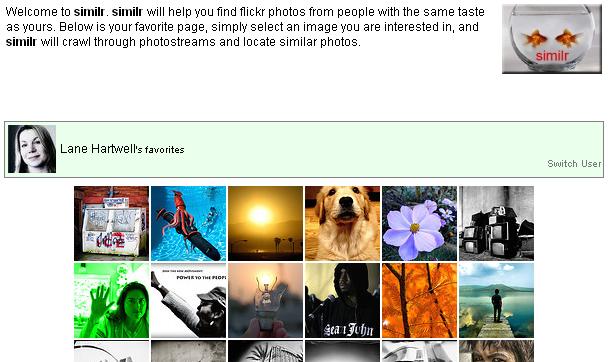 Similr is a tool that crawls Flickr photostreams for photos that are similar to the ones that you already like.
 It will first ask you for a flickr user; you can write in any user, not just yours. It will then load all of that user’s favorite photos and will allow you to select one of those. When you do so, it will crawl flickr’s photos, and look for favorites of contacts who also favored the photo you just selected. Complicated? Just try it out, but be warned, it’s very addictive.You can also enter an email address to start off. It can be hit or miss, but if you trust the taste and judgement of the user, then it's an easy way to filter out all the photos lacking interestingness to you.
Similr
Labels: Technology
VirtualWifi: Connect to Multiple Networks Simultaneously
It abstracts a single WLAN card to appear as multiple virtual WLAN cards to the user. The user can then configure each virtual card to connect to a different wireless network. Therefore, VirtualWiFi allows a user to simultaneously connect his machine to multiple wireless networks using just one WLAN card.Very, very cool. Even cooler, the source code is available too. VirtualWifi can also be used for more technical purposes to diagnose wireless failures, implement something called orthogonal channels that increases the capacity of a given network, or for fault diagnosis and recovery.
VirtualWifi
Labels: Technology
WinZip Now Supporting RAR
WinZip 11 Beta Download
Labels: Technology
Google Doubles Profit: Why Not Yahoo?

Google announced a doubling in third quarter profit this afternoon, trouncing rival Yahoo's weak performance earlier this week. The company earned $733.4 million, or $2.36 per share, in the third quarter, representing a 92 percent increase from net income of $381.2 million, or $1.32 per share, at the same time last year. Meanwhile, Yahoo earlier in the week announced profits were down 38%. Although summer is considered the weakest time of the year for Internet companies because the warm weather draws users away from their computers and Google's text ads, Google still managed to exceed analyst expectations. So, why is Google doing so much better than Yahoo? Where's the difference?
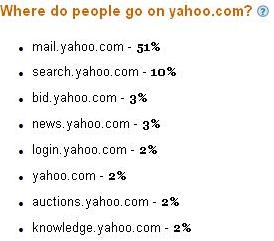
Yahoo Inc. is still essentially a portal company. As AOL's decision to open up its doors to the public earlier this year demonstrated, there is no longer any significant value in providing handholding services to users. The market has matured enough that users can find their own way around the web. In other words, search is now the starting point for many users, and one company immediately comes to mind: Google. Many users don't immediately associate Yahoo with search because the Yahoo brand has been used to market other services like shopping, email, and auctions. In fact, according to Alexa, 51% of users go to mail.yahoo.com while only 10% goes to search.yahoo.com. Google, on the other hand, has 72% of users going to google.com and 11% to mail.google.com.
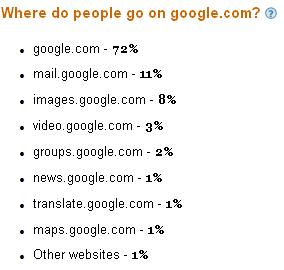 Why is this significant? Well, are you more likely to click on an ad while checking your mail or searching for something? Search is essentially a process of serendipity so users are more receptive to taking detours, say, by following attractive text ads. When five times as many users are using your email services as your search engine, that spells trouble for ad revenue. Users are very sensitive about their email. When Google indicated that ads were being targeted based on the content of users' email, that got a very negative reaction. In some ways, Gmail's deliberately slow spread was a blessing for Google since it's didn't draw users away from its search services.
Another way of visualizing the difference is in the two company's respective homepages. Yahoo's is cluttered with hundreds of links scattered across the page; the sort of design that is a legacy of the early days of the Internet.
 By comparison, Google's UI is clean and simple; search is emphasized above all else. There is no link to Gmail. From recent news, it looks like Google is starting to realize that "Yahoo Syndrome" is starting to creep up on it. Sergey Brin has been leading a companywide effort called "Features, not products". Apparently, users can only remember about a half-dozen or so Google products, not 35. Very dangerous, especially if users forget search is one of your product offerings.
 Yahoo also needs to control its brand dilution. When a user signs-in to Flickr, he gets taken to a Yahoo sign-in page. That's immediately jarring because there's otherwise no sign that Yahoo owns Flickr and using Flickr shouldn't also mean registering for a Yahoo account. So, it's rather smart that Google is keeping YouTube separate from Google Video since the two user demographics don't overlap very much.
Being too many things to too many people leads to the feeling that a company has no core competency. It also diverts resources away from improving core products into less crucial revenue sources. Again, the "Features, not products" campaign of Google fights against this tendency. Of course, for Yahoo, it's already a problem; the portal identity that it has retained from the early days is now a liability. Splitting off the various sub-domains of yahoo.com into their own separate, unique domains with new branding may revitalize the Yahoo brand by focusing attention on a few key products and giving a fresh chance for old products to attract new users who may be put off by the Yahoo brand name.
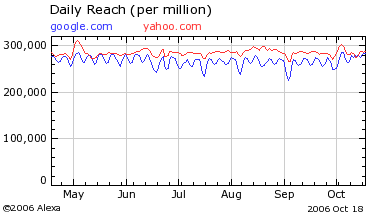
Search is key, judging by Google's example. It's the most basic activity of anyone browsing for information. Clearly, traffic isn't a problem since Yahoo has been consistently doing better than Google in attracting users. It's simply a matter of what services those users make use of. As long as users fail to think of "search" when they think "Yahoo", Google will continue dominating Yahoo.
Labels: Technology
A Brief Review of Internet Explorer 7
My first impression is not good. Some of the problems I encountered and solutions:
Somehow, the menu bar had disappeared, and I finally got it back by hitting F10. You also have to go to View->Toolbars and actually select Menu Bar for it stay put.
If you see blurry text when you're browsing, go to ClearType Tuner to fix it. You'll need to install an ActiveX control to use it.

I do like the built-in RSS reader except it crashed when I tried to subscribe to a feed. On the plus side, I did subscribe to the feed.
Now, if I could only get the tabbed browsing to work.
IE7 Download
Labels: Technology
Thursday, October 19, 2006
Yahoo! Answers Mobile Mashup

Mobile blogger Kevin has created a mashup that allows users to access Yahoo! Answers using their Windows Mobile Smartphone or Pocket PC. He decided to create the mobile mashup because he was frustrated at being left out of conversations about soccer. His story:
I could instantly become a soccer expert with Yahoo Answers on my cell phone. However, Yahoo Answers is just unusable in my mobile browser – the page took forever to load ( 3+ minutes for the landing page, and 4+ minutes to get a lis of related questions… yikers) and the extensive scrolling made the experience too painful. I could run the Answers site through a transcoder and get the page load times down, but I still end up scrolling and having to enter some long munged up URL. But not to worry… I spent a few weekends and evenings building the Mobile Ask mashup with the help of the Yahoo API, and it is now here for you!
Get the Windows Mobile Smartphone or Pocket PC build here.
(via Yahoo! Answers Team Blog)
Labels: Technology
How to Beat a Speeding Ticket
Blue lights... you're getting pulled over
1. Get your attitude right.2. Turn your car off, and turn the interior lights of your car on.
3. Be very polite and do exactly what the nice cop with the big gun says.
4. Once the officer has gotten your information, ask him politely if you may speak to him about your violation.
5. Ask to see the radar then ask a few questions.
6. Plea your case.
7. Leave the scene as a non-memorable, nice person.
You've gotten a ticket, but you still want out
8. Call the officer at work.9. Write a letter to the officer.
10. Repeat calls and letters to the judge and/or the prosecutor.
The court is your friend
11. Follow all court guidelines.12. Delay.
13. Ask for alternative punishment.
You can't handle the truth!
14. Understand your trial and your rights.15. Show up to your first court date and plead anything but guilty.
16. Go to court and duke it out.
17. Suck it up, or fight on.
18. Suck up... err, I mean write more letters.
The Unabridged Version of How to Beat a Speeding Ticket
Labels: Technology
Complete Darwin Works Online
Among the unique collection is the notebook used during the Beagle voyage, which would later forge his scientific arguments. It was stolen in the 1980s, but Darwin's great-great-grandson hopes that the publication online, thanks to a transcription from a microfilm copy made two decades earlier, will persuade whoever has it to return it.
Complete Work of Charles Darwin
Labels: Technology
Pop!Tech 2006 Streamed Live Now

Pop!Tech 2006 is taking place right now in Maine. This year is the tenth anniversary and is titled "Dangerous Ideas". The topics are usually dangerously addictive, and you can watch the streaming feed right now. Speakers include Thomas Friedman, Kevin Kelly, Richard Dawkins, and Ze Frank.
Update: Ethan Zuckerman has been blogging the event all day. If you'd rather read than watch, his posts are very in-depth.
In case you want to hear last year's Pop!Tech speakers, IT Conversations has them all archived.
Labels: Technology
Personalized Content vs. Power of Masses: Which Will Prevail?

As I blogged earlier, I tend to see Web 2.0 as, fundamentally, a race to see who can better pre-process, sort, or filter the ever increasing amount of information on the web (solving the information problem). By information, I include the news, but also other metrics that can be used to differentiate objects of interests. For instance, the "value" of a user as determined by the number of friends she has on MySpace. That tells you something like whether this user might be usefully recruited as corporate spokesperson because of her appeal in the social networking community, or perhaps whether she would be a compatible "friend" to make. The information problem social networking sites need to address is this, namely, "Is 'Allison' or 'De evilest 1' someone I want to befriend?" (eHarmony, the dating site, approaches this problem through a personality profile.)

Sites like Digg epitomize the concept of the Power of Masses, or wisdom of crowds. It's a relatively democratic process by which users vote for stories they like. As the Alexa traffic graph below indicates, Digg is much more popular than Reddit.
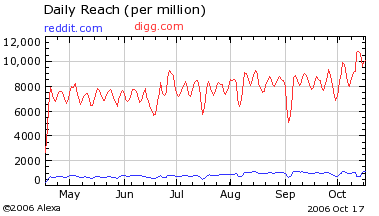
I think this is due to a couple of commingled factors: the communal nature of Digg and bad algorithms of personalized content sites. First off, Digg users seem to share a lot in common so stories that get filtered to the front page tend to interest most of the community. In comparison, Reddit's front page contained more diverse and less tech-related stories. Demographics are important. The majority of users who are joining the Diggs and Reddits of the web are likely to be tech savvy so a site that appeals to its user base's geekier impulses will be more appealing. Digg, for instance, has a bunch of neat tools that appeal to the geek demographic.

Reddit is unique among the personalized content sites because it also implements a Digg-like voting system, which I think will help keep it competitive against longtime rival Findory and newcomers like Feed 2.0. These personalized content sites appear to use algorithms that take into account keywords within stories that you read as well as the reading profiles of similar users to recommend stories that would interest you. That takes away the communal feeling that Digg possesses. Social media versus solitary media. The social aspect of Digg and other power-of-masses-based sites is a major part of their attraction. Collaboration and interaction make the information search and filtering process exciting and compelling (Google Image Labeler is an excellent example. transforming the monotonous task of labeling images into an interactive game).
Of course, a simpler explanation may be that Digg just looks more exciting. Digg is more colorful than Reddit, using yellows and blues liberally. Reddit, by comparison, is gray and white. Very boring colors.
The algorithms used by personalized news sites need significant improvement. At the moment, it might be easier to look in the Sports section of a news site to find sports stories, or rely on the wisdom of other users in voting up interesting sports stories as per Digg. Though I think Digg-like sites have structural advantages over personalized news sites, the next couple of years are likely to see significant improvement in natural language processing with search engines and personalized content sites racing to perfect it. Along with better algorithms, Reddit and its competitors will also benefit from increased awareness among the general public of their existence and mainstream use of personalized content services.
Labels: Technology
Cool Alexa Mashup: See Movers and Shakers by Country
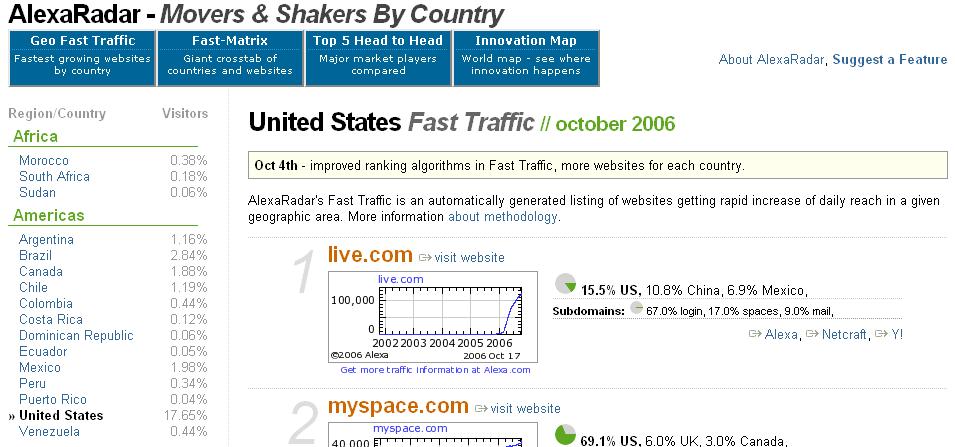
AlexaRadar is a neat Alexa mashup that lists sites getting a large increase in daily reach by geographic area. In the U.S., live.com, myspace.com, and google.com round out the top 3. All in all, it's a great tool to get a feel for what's hot in any given country. I especially like the Fast-Matrix that lists the top 5 sites for every country since I can quickly scan for overlap or differences globally. Looking at the top 5 gives a sense for how widespread the reach of any given site is.
AlexaRadar
(via The Paradigm Shift)
Labels: Technology
Wednesday, October 18, 2006
The Dumpster: Breaking Up as Art

The Dumpster is a very cool visualization of romantic breakups. A huge amount of data mining and analysis was necessary to create it. Here's a brief description of the project:
The Dumpster is an interactive online visualization that attempts to depict a slice through the romantic lives of American teenagers. Using real postings extracted from millions of online blogs, visitors to the project can surf through tens of thousands of specific romantic relationships in which one person has "dumped" another. The project's graphical tools reveal the astonishing similarities, unique differences, and underlying patterns of these failed relationships, providing both peculiarly analytic and sympathetically intimate perspectives onto the diversity of global romantic pain.A machine learning classifier was trained to spot romantic breakups in blog postings and score them for inclusion. A yellow circle (the Currently Selected Breakup) will show up initially, and other breakup bubbles are colored based on how similar they are to it.
The Dumpster
Labels: Technology
Music for Masses: Free MP3s from AllofMP3
Instructions:
1. Download and install the player:
- Download Music for Masses build 0.51 alpha version (~2.2 Mb)
2. Log in to allofmp3.com and order some tracks for free (see screenshot);
3. Download tracks with .mp3x extension to your regular download location;
4. Run the player, enter your allofmp3 login name and password;
5. Add songs to the playlist to start listening (or you may click on .mp3x files you downloaded to run the player and listen).
Note. You need to be connected to the Internet, otherwise it won’t play.
Labels: Technology
Internet Explorer 7 Officially Released
Download IE7
Related Posts:
Disable Automatic Install of Internet Explorer 7
Labels: Technology
Second Life Hits 1 Million

Over a million accounts have now been registered in Second Life with 70,000 over the past few days. I guess that Reuters story really started a landslide. Judging by the stats, Second Life is beating the odds in getting active participants (over 400,000 in the last 60 days). Much of that, I think, can be attributed to the virtual economy. Ownership matters a lot in getting people to stick around. If they've paid for a plot of virtual land, users are more likely to come visit it now and again.
Labels: Technology
Tor Anonymity Breached
The key tenet of Tor is that it should protect anonymity and the reader's analysis pointed not only to traffic modification on the part of a so-called "exit router" (the last hop in a Tor circuit before your packets reach the real destination) but also an attempt at tracking the true origin of the traffic (in a Tor network a hop only knows that the traffic comes from a previous hop but no futher back).The authors recommends turning off Flash, ActiveX, Javascript, and Java to protect your anonymity. It also wouldn't hurt to use a text-based browser like Lynx.
(via Download Squad)
Labels: Technology
Social Networking and its Discontents: What's Wrong with Social Networking?
"The superficial emptiness clouded the excitement I had once felt," Henderson wrote in a column in the student newspaper at Iowa State University, where he studies history. "It seems we have lost, to some degree, that special depth that true friendship entails."The majority of the article focuses on how people, the tech generation in particular, are not spending enough time in face-to-face encounters with friends, and how that is a bad thing. I think what they're missing is that social networking as it stands at this point in time is actually very bad at promoting friendships. Why does Gabe feel that his tech-enabled interactions are hollow and empty? Because social networking sites promise one thing, but deliver something altogether different.
It's not that online interactions are bad inherently, but that the current array of options that enable social interaction is lacking. I think that most people don't really use social networks as they are meant to be used because sites like MySpace and Facebook are little more than glorified personals ads. As Gabe describes
"I'm not sacrificing friends," he says, "because if a picture, some basic information about their life and a web page is all my friendship has become, then there was nothing to sacrifice to begin with."There is a lack of substance and depth that undermines the stickiness of social networking sites. Real friendships are rarely formed on them. A few reasons why even fewer friendships are likely to formed in the future:
- Increasing commercialization: Companies that wish to advertise their products come up with all sorts of creative ways like setting up their corporate mascot with a user profile for people to friend or even deliberately misrepresenting themselves (Brody Ruckus of Ruckus Network on Facebook). I've written previously about Metcalfe's Law, which states that the value of a network goes up with the square of the number of users. However, these commercial profiles are like black holes. They suck in connections as other users friend them, but those users don't find friends by looking at the list of Helga the Volkswagen mascot's friends. These connections have no value (even negative value) because they dead-end and are very weak (based on whimsy and not on deliberation). The very falseness of these mascots or corporate profiles erodes the point of social networks. They are an embodiment of the broken windows theory. Social networking sites become "bad neighborhoods" when companies jump into the mix. Corporate users erode intimacy and trust that are the cornerstones of real friendship.
- Celebrity: By this, I mean users who have built-in fanbases like bands and other artists. They gather "friends" who have similar tastes (they love that band), but the relationship becomes one of a fanclub where users are there for the band and not for the rest of the network. In a sense, even though these users have joined a social networking site and are "active" participants, they are essentially lurkers. They aren't there to socialize, but to be part of the spectacle. Trying to friend these users is like typing in a URL and getting a 404 error. They are broken links in the social network.
- Decreasing trust: As the MySpace predator story illustrates, there are users of social networks that are even more corrosive than corporations. While this is nothing new, I think that in the future, the dumber online predators will stop using their real names when signing up for accounts. Increasing publicity of how dangerous social networks can be will cause more and more users to beg the question: How do I know that my "friend" isn't a predator?
Related Posts:
The Anatomy of Web 2.0: Putting it in Context
The Growth of Social Networking Sites, Redux
Is The Social Networking Market Saturated?
How Sticky Are Social Networks?
Participation Inequality: The New Pareto Principle (90-9-1 Rule)
The Rise of Specialized Social Networks (Plus a Review of SocialPicks)
Labels: Technology
New Googlebot Tools for Webmasters

Google has updated their tools for webmasters. You can now see Googlebot activity charts that list the number of pages Googlebot's crawled from your site per day, the number of kilobytes of data Googlebot's downloaded per day, and the average time it took Googlebot to download pages.
Webmasters can also alter the crawl rate at which Googlebot indexes pages on your site. Googlebot's crawl rate is based on how often you update your site, but you can choose a slower rate if your server can't handle the load. Currently, changed settings only last for 90 days.
There's also an option to opt-in to Google Image Labeler so images on your site will be associated with labels to make searching for them easier.
If you aren't using Google's webmaster tools, you should be since getting indexed is key in getting traffic. You can see if there are any problems that Googlebot has in indexing your site's pages and try to fix any broken links or missed pages.
Labels: Technology
Tuesday, October 17, 2006
CNET Review of RSS Readers
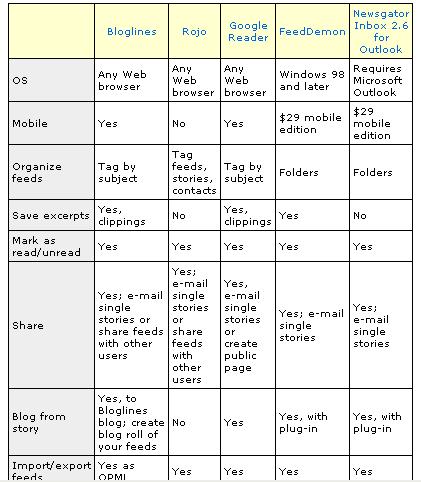
(via Micro Persuasion)
Labels: Technology
Fraud Protection in Opera, Firefox, IE

With Opera announcing that version 9.1 of its amazing browser will come with fraud protection, all three browsers (Firefox, Opera, IE) are coming out with anti-phishing protection. While each of the three implementations are slightly different, this should help stop fraudulent websites that attempt to impersonate legitimate sites to steal passwords and credit card information.
Opera's implementation relies on checking a site's IP against a list maintained on a remote server. They promise not to keep records of IP lookups. Firefox like IE relies on a list of bad sites that comes with the browser that is regularly updated. You also have the option to check against an online site for real time protection.
Labels: Technology
Free Computer Books
Update: FreeTechBooks also has a wide collection that is regularly updated.
FreeComputerBooks
FreeTechBooks
Related Posts:
Never Visit a Bookstore Again: Hundreds of Free Science Fiction Books
Labels: Technology
Blogger Bug?: Unauthorized Posts on Official Blogger Blog
white chocolate sugar skulls
Diary of a Crafty Chica: White Chocolate Sugar SkullsThis might be related to another post indicating that there's a bug that makes people from one blog accidentally post to another blog.
i love these! it seems so obvious - replace the sugar with something you’d actually eat - but yet, what a surprise.
if i get my act together, i am totally making these for dia de los muertos this year.
sure, i’ll get around to it. along with finishing painting the toy box for my nephew, and doing nanowrimo, which i promised a friend i’d take part in this year (and actually finish the novel i’ve been working on? that would be shocking.) but other than that, i don’t really have many projects - hahahaha!
good thing i subscribed to CRAFT. yeah, right! just got my first one the other day - it’s super cute, and there are wayyy too many projects to keep me over-busy and inspired!
(via Google Blogoscoped)
Labels: Technology
Got a Feature Suggestion for Gmail? Google Wants to Know
PersonalizationYou can pick 5 of these, or suggest a better idea. It looks like they take suggestions seriously with about 10 suggestions having already been implemented.
Customize my Gmail color scheme
Create my own keyboard shortcuts
Automatically email my new Gmail address to all of my contacts
Always display external images sent by my contacts
Organization
Filter my outgoing messages
Switch Conversation View on or off
Bells & Whistles
Delete attachments from a message
Import messages from my other email accounts
Automatically apply new filters to old conversations
Helpful Additions
Ability to add or remove messages from conversations
Click a button to delete a message
Control whether people I send mail to are added to Contacts
(via CyberNet News)
Labels: Technology
The Anatomy of Web 2.0: Putting it in Context
I'm going to be writing an overview of Web 2.0 as I see it. For some readers, a lot of what I'll be exploring will be old news, but this is in part a way for me to gain some perspective on the period of history we're living in.
I've been writing extensively on social networking sites recently (list at bottom), and now I'll be changing gears a little, broadening my scope.
The following is highly tentative.
Defining Web 2.0
Web 2.0 is now. It's the time we're living in, and we're all taking part in it. Whereas Web 1.0 a.ka. the dot-com boom was about transitioning elements of the real world into cyberspace and taking the first steps toward an information revolution, Web 2.0 is about personalizing the virtual experience, taming it in a sense. With RSS feeds, learning algorithms deployed to understand what information interests you, memetrackers, and other extensions to simplify and pre-process the enormous flows of information online, a vast number of people and companies are trying to deal with the information problem, extracting signal from noise. This is not as easy as it sounds since what is signal for one person is noise for another.
This second wave of teeming creativity is also characterized by attempts to bring people from around the world together into a social network. These social networking sites purport to allow users to make friends with others in distant places and facilitate the growth of genuine relationships. While they may fails at times in delivering what they promise, these social networks are hubs, attractors for communities to stabilize around. As networks, they become more powerful and attractive as more and more users join. Potential connections between users skyrocket with increasing membership. Users must make the choice whether to join based on certain considerations: stability of the network (Will MySpace go bankrupt in three months?), power of the network (How many users are there?), and other personal factors (Are my friends on Facebook? Is Friendster a cool place to hang out?).
Social networks also serve another purpose: they assign value to objects, whether efficiently or not. One user may be distinguished from another by the number of connections (friends) he or she possesses (Tom of MySpace may be king in that regard). The more links the more valuable the user (Mental note: Make Tom my friend.). Similarly, social bookmarking sites act as collaborative filters in solving the information problem, selecting the wheat from the chaff. The value of a page is dependent on the number of votes it receives whether expressed as votes or number of people saving it. By harnessing a distributed network of users, social bookmarking sites are able to more efficiently search through the potential space of interesting pages.
A third semi-independent platform of Web 2.0 is bringing reality into the virtual world. Reality realized (beta). As social networks approximate the reality of human relationships, VoIP, video sharing sites, and virtual worlds like Second Life allow the higher fidelity sharing of experiences. VoIP lets strangers, who have formed some level of connection, talk to each other. The voice can communicate much more richly than mere text. Video sharing lets users share asymmetrically with the world at large. They are, in part, platforms for self-expression without expectation of response. Perhaps more cathartic and memorable than a text posting on Livejournal or scribbling in a diary. While VoIP and video sharing are firmly planted in Web 2.0, virtual worlds offer a glimpse of Web 3.0. Here, users share the task of building a world to inhabit, each pixel potentially having been freshly coded just seconds ago. And, perhaps, eventually live in full time.
Watch for updates since this post is still highly in flux.
Your thoughts? Agree? Disagree?
Related Posts:
The Growth of Social Networking Sites, Redux
Is The Social Networking Market Saturated?
How Sticky Are Social Networks?
Participation Inequality: The New Pareto Principle (90-9-1 Rule)
The Rise of Specialized Social Networks (Plus a Review of SocialPicks)
Labels: Technology
Firefox 2 RC3 Released
If you want to suggest features for Firefox 3, go here.
Related Posts:
10 Reasons Why Opera is Better Than Firefox
Labels: Technology
Search Flickr by Sketch with Retrievr

Retrievr is probably one of the most unique search engines out there. I think almost all other search engines rely on text input to conduct searches, but Retrievr allows you to search Flickr images by drawing a sketch. You can choose the thickness of your brush and color. Based on some tests, color seems to influence the search results more than shape. Drawing the shape of a car probably won't return pictures of cars, for example. The programmer Christian Langreiter describes how it works:
Retrievr creates and stores a compact representation of each photo in its database. The system pulls only the most important features -- broad shapes, blocks of color and spatial relationships between different colored areas -- out of detailed images to create shorthand approximations of every photo. (The storage mechanism extracts the 120 "strongest" features from an image to create something called a "wavelet transform," which contains much less data than the photo itself and facilitates lightning-fast searches.)To get the best results, Langreiter has this recommendationThese photographic abbreviations are compared with the user's sketches, and Retrievr suggests matches. Mr. Langreiter advises Retrievr artists "to capture the grand scheme of things" to achieve the best results.
![[Retrievr searches for an apple]](http://online.wsj.com/public/resources/images/OB-AD665_TW_No2_20061016203357.jpg)
"You have to get the colors right and the location," he says. "The details are not that important in the algorithm." Mr. Langreiter urges users to remove as much detail as possible from drawings and to avoid working in a line-art style all together; the key is well placed blobs of color.
Labels: Technology
Monday, October 16, 2006
Battle of the Memetrackers: Techmeme vs. Tailrank


First off, a memetracker is a site that tracks breaking news in the blogosphere. That said, with Tailrank 2.0 being released today, I thought it might be interesting (as did others) to compare it with current leader Techmeme. While I like the color scheme of Tailrank, it doesn't scan as well as Techmeme. There are maybe 10 or 12 stories listed right now on the Technology page compared to maybe 30 to 40 on Techmeme. Right there, that's a disadvantage since I have to spend time clicking through to get a deeper pass through the latest news.
Depth is also important. Right now, Tailrank indexes 110K blogs, but is planning to expand to 250K soon. Techmeme only a few thousand. So, Tailrank does live up to its name by keeping an eye on the long tail of blogs. It also allows searches unlike Techmeme. There are also areas of overlap. Top stories right now are MySpace predators, Edelman and Wal-Mart, and the New York Times on social networking sites.
Overall, Techmeme is like subscribing to an RSS feed that only covers stories from a select few sites while Tailrank has the potential to link to stories that aren't dominated by the major blogs. I'm sticking to Techmeme for its one pass display of the latest news, but I'm guessing that Tailrank will race ahead in features and comprehensiveness if it hasn't already.
Labels: Technology
How to Detect Lies: Body Language, Speech Patterns, and Gestures
• The guilty person may speak more than natural, adding unnecessary details to convince you... they are not comfortable with silence or pauses in the conversation.
• If you believe someone is lying, then change subject of a conversation quickly, a liar follows along willingly and becomes more relaxed. The guilty wants the subject changed; an innocent person may be confused by the sudden change in topics and will want to back to the previous subject.
• Expressions are limited to mouth movements when someone is faking emotions (like happy, surprised, sad, awe, )instead of the whole face. For example; when someone smiles naturally their whole face is involved: jaw/cheek movement, eyes and forehead push down, etc.
• Hands touching their face, throat & mouth. Touching or scratching the nose or behind their ear. Not likely to touch his chest/heart with an open hand.
How to Detect Lies
(via del.icio.us)
Labels: Technology
YouTube Gaming: How to Get Your Video to the Top of the Charts

Pete Cashmere at Mashable! has a great blog about gaming YouTube. How do you get your video to the frontpage of YouTube? Simple: set your browser to refresh your video's page overnight and wake up to see your clip on the frontpage of YouTube. More fun commentary:
There are a plenty of top users who are obviously employing this tactic: did this guy become one of the most viewed videos today because his four second clip about North Korea is so compelling? (Update: that video is no longer showing up in the Most Viewed list, but he’s trying the same tactic with this one). This is the same guy who garnered almost 200,000 views for WoW is Evil - a four second clip in which nothing happens. If you look at his account, he’s watched 299,221 videos this year - about 68 videos an hour if you assume a 12 hour day and 7 days a week spent on YouTube. That’s possible, but it’s far more likely that he forgot to log out of his account on one occasion. What’s more worrying is that enough people complained in the comments to make the video rise to the top of the “Most Discussed” list, too.Obviously, IP logging would mostly prevent this sort of YouTube gaming. I wouldn't be surprised if it gets implemented within a few days.
Labels: Technology
Stalk Amazon Price Changes

Matt over at FantasyLife recommends RSStalker (yes, it's RSS Stalker less an "S") to anyone looking to track the price changes of a product at Amazon. It's very simple to use. Just enter the ASIN, ISBN (for books), or even URL of the product you want to track, and RSStalker will generate an RSS feed for you to subscribe to. Any time the price changes, you'll be notified. You can also track wishlists and categories.
One additional feature I'd like to see would be an option to set the level of price change (say, notify me when the price drops 25% or more), but that would ruin the simplicity of the user interface. Maybe an advanced options tab on the side.
RSStalker
On a side note, RSStalker would be such a good name for an RSS aggregator. It seems a little wasted on tracking Amazon products.
Labels: Technology
Reuters Embeds Reporter in Second Life

Reuters is set to launch a news bureau in Second Life, the popular 3D virtual world, on Wednesday. It's planning on offering text, audio, and video news, covering both Second Life and "First Life" news. Reporter Adam Pasick based in London will be embedded as the avatar Adam Reuters. In this effort, Reuters is joining companies like Adidas and American Apparel, who are offering clothes and accessories for people to dress up in.
While Second Life has been getting a lot of press coverage recently, it's still a relatively small community compared to other social networking sites. It's significant because it is the apotheosis of the very concept of social networking and has a functioning virtual economy that interfaces with the real world economy. Also, users who create items in Second Life own those items so they can choose to freely distribute or charge for them, creating an exchange economy. Still, these efforts are likely to be as much publicity stunt (a way for companies to appear to be on the cutting edge of cool) as genuine belief in Second Life's commercial potential.
Here's an overview of Second Life:
Created by Linden Lab in San Francisco, "Second Life" is the closest thing to a parallel universe existing on the Internet. Akin to the original city-building game "SimCity," "Second Life" is a virtual, three-dimensional world where users create and dress up characters, buy property and interact with other players.
More than 900,000 users have signed up to build homes, form neighborhoods and live out alternative versions of their lives in the 3D, computer-generated world. Players spend around $350,000 a day on average, or a rate of $13 million a year. Usage is growing in rapid double-digit terms each month.
Labels: Technology
Search With Personality: The Incredible Ms. Dewey

Ms. Dewey is an interesting take on search. She's a highly amusing and provocative avatar, especially when you don't search for something. While the search results are decent, the real draw is the personality.
From a little detective work, it looks like Ms. Dewey is powered by Microsoft's Live.com. Is Ms. Dewey Microsoft's next Clippy?
The domain is registered to EVB, which seems to specialize in creating highly novel, experimental campaigns for companies like Doublemint and Adidas. Maybe Live.com is going in for an extreme makeover.
Definitely try Ms. Dewey.
(via Google Operating System)
Labels: Technology


